


As retailers were adjusting to the 30% tariffs the US imposed on Chinese imports, they faced difficulties when Mr. Trump announced an additional 100% increase.
The US President’s October 10 announcement caused the US stock market to record its sharpest decline since April last weekend. Shares of major retailers, such as Abercrombie, Best Buy, and Nike, all plummeted.
Two days later, Mr. Trump reassured the market with a post on the social network Truth Social: “Don’t worry about China. Everything will be fine.” The market then reacted positively, with all three major Wall Street indexes rising in the first session of the week. Retail stocks also improved.
Chinese imports account for about 17% of sales in the US. Last month, imports of key consumer goods from the world’s second-largest economy fell 27% year-on-year, mainly toys, furniture, fashion and electronics. The consumer electronics industry remains heavily dependent on Chinese goods. Therefore, the 100% tariff from November 1 will be a heavy blow to US retailers and consumers.
After figuring out how to adapt to the 30% import tax on Chinese goods, retail giants like Abercrombie & Fitch, Levi Strauss, Kroger, TJX and Walmart have all recently raised their earnings forecasts. But Mr. Trump’s tariff announcement came so quickly that they didn’t have time to make the necessary adjustments.
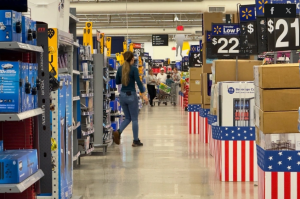
Inside a Walmart store in Oceanside, California in May 2025. Photo: Reuters
A September KPMG survey of 300 senior executives found that less than 25% were confident in the stability of tax policy. About 43% said they would need 7-12 months to change their supply chains if tariffs increased.
“The retail industry has a new concern. They have shown the ability to adapt to Trump’s tax policy, but the most difficult thing to control is the volatility of tax rates,” said Arun Sundaram, an analyst at CFRA.
During a recent earnings call, Walmart CEO Doug McMillon said the impact of the tariffs “is still slow, so consumer behavior hasn’t adjusted much.” However, that could change if the new tariffs are implemented.
Reuters said that by 2023, Walmart – the world’s largest retailer – will import about 60% of its goods from China, while Amazon – the second largest online retailer in the US – will import 70%, according to estimates by Wedbush Securities.
The threat of tariffs totaling 130% on Chinese goods has added to the gloomy retail picture as the holiday shopping season approaches. The National Retail Federation (NRF) has postponed its year-end retail sales forecast to November 6, the first time since the pandemic.
In April, Mr. Trump threatened to impose tariffs of up to 145% on China. However, in May, the two countries reached an agreement to reduce this figure to 30%. The upcoming 130% tariff is considered to have a significant impact, especially when the US inflation rate increased by nearly 3% in August. September figures have not been released due to the government shutdown.
KPMG’s survey also found that 35% of businesses reported a decline in sales and 31% said customers postponed purchases. 39% of retailers reported a decline in gross profit. About 44% of companies expect the decline to continue into next year and 66% of retailers have passed on more than half of the tax costs to consumers through price increases.
Uncertainty over tax policy has caused 57% of businesses to postpone major investments. Nearly 40% have stopped hiring, and 29% have reduced their workforce by 5%.
Retail is also the industry hardest hit by job cuts, according to human resources consultancy Challenger, Gray and Christmas. In the first five months of the year, companies in the industry cut 76,000 jobs, a 274% increase from the same period last year.
The outlook for holiday hiring is also bleak. Companies expect to hire just under 500,000 seasonal workers, fewer than last year. “The wave of uncertainty is hitting retail and consumers as the final quarter approaches,” says human resources consultancy Challenger, Gray & Christmas.
Over the past few months, the industry has been shifting its supply chain and increasing its resilience through various plans. However, a 100% tariff increase could be more than they can handle. “Tariffs are changing faster than supply chains,” said Manoj Kothiyal, director of consulting firm BCG.
He called the tax the new inflation, and advised retailers to be transparent about rising costs. “Tell us that we will maintain the same quality and sourcing standards despite changes in global trade. Transparency will create confidence in price, which is as valuable as brand,” he said.
Kothiyal also warned that the situation is fluid. “Taxes may be adjusted, renegotiated or increased, depending on the stage. The goal of businesses is not to predict the next change, but to be ready for all of them,” he concluded.

















Leave a Reply