


The Mysterious Giant Palantir Becomes the Center of a Fierce Wall Street Battle as Michael Burry Bets Nearly $1 Billion Against It
The mysterious giant Palantir has become the center of a fierce battle on Wall Street, after legendary investor Michael Burry placed a nearly $1 billion short bet against the company. This wager is not just about money—it’s about the future of a powerful and controversial technology empire.
In early November 2025, a disclosure sent shockwaves through Wall Street: Michael Burry, the hedge fund manager of Scion, immortalized in The Big Short, had taken $1.1 billion in total short positions against two of the hottest tech stocks on Earth — Nvidia ($187 million) and Palantir ($912 million).
Nvidia has become a household name. It’s the most valuable company on the planet, at times boasting a market cap over $4.5 trillion, supplying 90% of the world’s AI chips, and standing at the heart of the U.S.–China artificial intelligence race.

But Palantir — the main target of Burry’s short — is a bit more enigmatic to global investors. What exactly does Palantir do? Is it a bubble on the verge of bursting? And could Michael Burry be wrong in betting against this secretive powerhouse?
From PayPal to the Pentagon: The Origins of a Data Empire
To understand Palantir, we must start with billionaire Peter Thiel and the so-called “PayPal Mafia.”
This group of early PayPal founders and executives went on to create some of Silicon Valley’s most iconic firms — YouTube, LinkedIn, Yelp, and Tesla among them.
At PayPal, Peter Thiel witnessed firsthand the power of data analytics to detect and prevent fraud in online payments. That experience sparked an idea: If technology can find financial fraudsters, why not terrorists?
In 2003, amid lingering fear after the 9/11 attacks, Thiel joined forces with the eccentric Dr. Alex Karp, a philosophy Ph.D., and a handful of elite engineers to found Palantir.
The company’s name was inspired by the seeing stones from The Lord of the Rings, which granted the ability to see events across time and space. “Palantir” was a fitting metaphor for the company’s mission: to see the hidden connections within massive oceans of data.
The first outside investor in Palantir was none other than the CIA, through its venture arm In-Q-Tel. This fateful partnership embedded Palantir deep within America’s national security apparatus from its earliest days.
The Operating System of Power
Palantir doesn’t sell software you can install from a CD or a simple .exe file. Instead, it builds data operating systems that become deeply integrated into the operations of its clients. Its main products include:
Gotham – Palantir’s first product, designed for intelligence and defense agencies such as the CIA, FBI, and NSA.
Gotham aggregates data from countless sources — phone intercepts, bank records, satellite imagery — to create a “big picture,” helping U.S. forces map bomb networks in Afghanistan or law enforcement track criminal networks.
Foundry – Gotham’s “civilian twin,” built for corporations. Global giants use Foundry to solve their most complex problems: JPMorgan Chase to detect fraud, Airbus to optimize supply chains, BP to simulate oil rigs, and Merck to manage clinical trials.
Apollo – The engine that keeps both Gotham and Foundry up to date and secure, even across top-secret government networks.
AIP (Artificial Intelligence Platform) – Palantir’s newest product, allowing organizations to integrate generative AI into their internal data. It lets a general predict enemy attacks or a corporate executive anticipate supply-chain disruptions.
A Controversial Empire
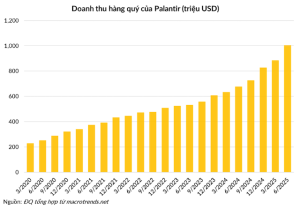
From a secretive startup, Palantir has grown into a $461 billion technology empire as of November 10, 2025. But its rise has always come with controversy.
First, its role in surveillance and immigration enforcement.
Palantir’s platforms power critical analytics for the U.S. Immigration and Customs Enforcement (ICE) agency, helping it track and target deportation subjects. Critics say the technology has enabled mass arrests and humanitarian crises — such as separating children from parents during workplace raids.
Second, concerns over privacy and predictive policing.
Palantir’s tools allow police departments to forecast where crimes might occur and even identify individuals at risk of committing them.
Civil rights groups warn that these algorithms can entrench racial bias — as they’re trained on historically biased data — creating a feedback loop: more patrols in minority neighborhoods → more arrests → more biased data fed into the system.
Third, Palantir’s expansion into sensitive civilian sectors.
In the U.K., the company won a £330 million contract to manage and analyze the National Health Service (NHS) patient data. Handing over the medical information of 68 million Britons to a defense contractor with CIA ties has sparked deep concerns over data sovereignty and privacy.
Stock Bubble or Market Manipulation?
After news of Burry’s massive short position broke, CEO Alex Karp called the move “crazy” and “market manipulation.”
Karp argued that Palantir had just reported its strongest earnings ever — and there was no rational reason for anyone to short the company’s stock.
Burry fired back on social platform X (formerly Twitter):
“Not surprising that Alex Karp and his ‘ontology’ can’t decipher a simple 13F report.”
Here, Burry mocked Karp’s background — the CEO earned a Ph.D. in philosophy in Frankfurt and often references ontology in interviews — implying Karp misunderstood the nature of Burry’s short position.
When Being Early Means Being Wrong
As portrayed in The Big Short, Burry began shorting mortgage-backed securities in 2005 using credit default swaps (CDS). At that time, the U.S. housing market showed no clear cracks. As long as the bubble didn’t burst, Burry’s fund had to keep paying CDS premiums, hurting performance.
When one of his largest investors threatened to pull out, Burry famously said:
“I may have been early, but I’m not wrong.”
The investor replied:
“That’s the same thing.”
That exchange perfectly captures the risk of Burry’s strategy.
Wall Street history is full of investors who correctly identified bubbles and shorted them — only to be ruined because the bubble inflated far longer than reason would allow. As John Maynard Keynes once said:
“The market can stay irrational longer than you can stay solvent.”
Burry may be right that Palantir is overvalued. But in a market intoxicated with the boundless potential of AI, irrationality can last a very long time.
Palantir’s power lies not just in its financials, but in its strategic entrenchment — its deep integration into the “nervous systems” of the most powerful governments and corporations on Earth.
Once you become the “operating system” for the Pentagon or the NHS, you’re nearly impossible to replace. That technological and institutional entrenchment is Palantir’s economic moat — and Burry may have underestimated it.
The battle between these two titans is far from over. But it reminds the world that in the age of AI, the line between a great tech company and a dangerous speculative bubble has never been thinner.

















Leave a Reply