


The biggest challenge facing the global economy in 2025 can be summed up in a single word: tariffs.
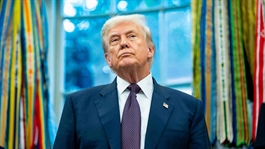
U.S. President Donald Trump upended America’s long-standing trade relationships when he announced the imposition of reciprocal tariffs on most countries around the world on April 2, 2025.
This was followed by months of policy adjustments and tense negotiations. Some countries reached agreements with the White House to reduce tariffs, while others—most notably China—were temporarily exempted or granted delays in the application of higher tariffs on their exports to the United States.
Tariffs have become the preferred tool used by Washington in its effort—according to the Trump administration’s perspective—to address trade imbalances with major partners such as China and the European Union (EU), which the U.S. believes have benefited disproportionately and unfairly from the global trading system.
Although several trade agreements have been signed this year—with the United Kingdom, the EU, Japan, South Korea, Vietnam, the Philippines, and Indonesia all reaching framework agreements with the U.S.—the detailed implementation of these commitments is still taking place behind the scenes.
Throughout this period, uncertainty has continued to loom over the future of the global tariff system as the U.S. Supreme Court prepares to rule on the legality of the reciprocal tariffs imposed by President Trump. Trump has warned that the U.S. economy could face an “economic catastrophe” if the court issues an unfavorable ruling.
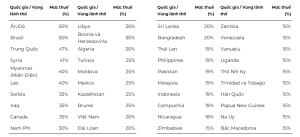
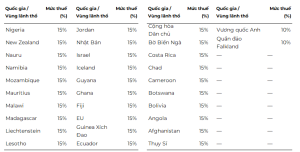
Countries facing the highest tariffs
As of December 2025, several countries have still failed to persuade Trump and his U.S. trade team. Among them, Brazil and India stand out as notable cases, facing tariffs of up to 50%.
The decision to impose high tariffs on Brazil came after Trump declared that the Brazilian government’s policies posed a threat to U.S. interests. Meanwhile, India saw its tariffs increased due to its continued purchases of oil from Russia, despite Washington’s efforts to apply pressure.
Tariffs on the two neighboring countries, Mexico and Canada, had been under consideration by the U.S. for a long time, even before the reciprocal tariff system was announced earlier this year. Accordingly, Mexico faces a 25% tariff, while Canada is subject to a 35% tariff on goods not covered by the United States–Mexico–Canada Agreement (USMCA).
The USMCA itself is also set to be reviewed in 2026. The United States is currently considering whether to continue maintaining the agreement or to shift toward negotiating separate bilateral agreements with each partner.

















Leave a Reply