


Foreign investors are returning strongly to China’s stock market, with trading volumes reaching their highest level in four years. This is a sign that global investors are reassessing a market that until recently was considered “uninvestable.”
In the first 10 months of the year, foreign inflows into Chinese equities reached 50.6 billion USD, up from 11.4 billion USD in 2024, according to data from the Institute of International Finance (IIF), the global banking industry group.
Chinese stocks listed both on the mainland and in Hong Kong have surged this year, fueled by an AI boom following DeepSeek’s breakthrough model release, as well as a wave of robust listings in the Asian financial hub.
This sharp rebound comes after several bleak years when foreign investors dumped their positions due to concerns over slowing economic growth and rising tensions between Washington and Beijing.
“China still trades at a record discount compared with the rest of the world, yet it has some of the best companies in tech,” said Jonathan Pines, Head of Asia ex-Japan Equities at Federated Hermes. “They are the only real competitors to the U.S. in certain areas.”
Foreign capital retsurns to Chinese equitie
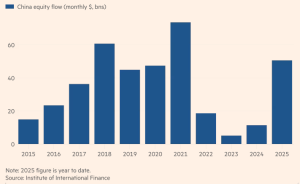
This year’s foreign buying remains below the 73.6 billion USD record set in 2021, when the CSI 300 index rebounded sharply from the pandemic shock to hit all-time highs. Even so, it marks a notable reversal after years of declining foreign interest.
“Two years ago, China was an uninvestable market for many people,” said Yan Wang, Chief Emerging Markets and China Strategist at Alpine Macro.
Beijing stopped disclosing daily data on foreign investment into mainland-listed Chinese stocks via Hong Kong last year, making it harder to track inflows. IIF monitors foreign investment flows into China, excluding Chinese companies listed in the U.S.
According to Citi, purchases of Chinese equities have risen sharply since the U.S. imposed its “Liberation Day” tariffs in April, with a buy-to-sell ratio of about 55% to 45%.
This year, foreign asset managers have been net sellers of Chinese stocks, but this has been offset by inflows into passive funds, according to EPFR Global data.
Chinese stocks remain undervalued compared to other markets
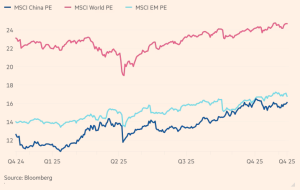
Chinese stocks remain undervalued compared to other markets
The rally in Chinese equities this year has been driven mostly by domestic retail investors, said Stuart Rumble, Head of Investment Directors for Asia-Pacific at Fidelity International.
Mainland Chinese investors have poured 1.3 trillion HKD (about 168.7 billion USD) into the Hong Kong stock market this year—a record level—and now account for around 20% of total turnover there.
Previously, foreign investors were cautious about Chinese stocks for three main reasons: the real estate crisis, Beijing’s regulatory crackdown on private businesses, and the escalating U.S.–China trade war. These factors caused the Chinese stock market to fall nearly 50% from its peak.
“There was a time when people simply didn’t want to talk about [China],” said Daniel Morris, Chief Market Strategist at BNP Paribas Asset Management. “Now we talk about China quite a lot.”
Beijing’s crackdown on private enterprises—symbolized by the downfall of Alibaba founder Jack Ma—is believed to have severely damaged investor confidence. Regulators have since pushed through a range of reforms to revive the market. “It’s clear they want capital markets to rise again,” Pines said.
Foreign inflows into Chinese stocks have surged this year even as many U.S. state pension funds, such as those in Texas and Indiana, have exited Chinese companies due to unstable U.S.–China relations.
Some investors are seeking exposure to China’s innovative tech companies, partly to diversify their portfolios instead of concentrating solely on the U.S. market, which is near record highs. Stocks like Alibaba remain far below their peaks and trade at cheaper valuations than their U.S. counterparts.
“You don’t want to put 100% of your portfolio into the Nasdaq,” Morris said.

















Leave a Reply