


Global bond markets were hit by a sharp sell-off on December 1 after the Bank of Japan (BOJ) signaled a possible interest-rate hike, triggering widespread pressure from Tokyo to New York and heavily impacting Bitcoin and other speculative assets.

The shockwave began with remarks from BOJ Governor Kazuo Ueda, who said the central bank could raise interest rates as early as December. The immediate reaction saw Japan’s 2-year government bond yield rise above 1% — a level not seen since 2008. The 10-year yield also climbed 0.07 percentage point to 1.87%.
Volatility from the Japanese market quickly rippled across the globe like a domino effect. The yield on the U.S. 10-year Treasury — a benchmark for trillions of dollars in global assets — jumped 0.08 percentage point to 4.09%, marking its biggest one-day increase in a month. Similarly, Germany’s 10-year government bond yield rose 0.06 percentage point to 2.75%.
Matt Miskin, Co-Chief Investment Strategist at Manulife John Hancock Investments, commented: “The global bond market is experiencing a butterfly effect after the BOJ’s rate-hike signal.”
The bond sell-off created a double blow for risk assets. As investors can now earn higher yields from safe-haven assets such as government bonds, the appeal of riskier investments naturally declines.
Bitcoin and cryptocurrencies plunge
The crypto market was hit the hardest, with Bitcoin tumbling 5.5% during the session, pushing its total one-month loss to more than 20%. Crypto-related stocks also fell sharply: Coinbase — a major digital asset exchange — dropped 4.8%, while Bitcoin-holding firms slipped more than 3%.
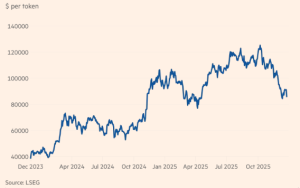
Jasper De Maere, a specialist from the crypto-trading group Wintermute, explained: “Low interest rates in Japan supported carry trade strategies, but now they are unwinding, and all risk assets are being sold off.”
Carry trades — where investors borrow low-interest yen to invest in higher-yielding assets — are now reversing, adding more selling pressure to high-risk assets. The yen also appreciated 0.6% against the U.S. dollar, reaching 155.3 per dollar as markets bet heavily on upcoming BOJ rate hikes.
The BOJ’s move carries deeper implications for global financial markets. For years, Japanese investors poured money into overseas bonds in search of higher yields. Now, with domestic rates rising, they may repatriate capital, removing an important source of funding from international bond markets.
Michael Metcalfe, Head of Global Macro Strategy at State Street Markets, warned: “Clearly, as Japanese interest rates normalize, the likelihood of Japanese investors repatriating funds from foreign bond markets increases. This removes a key source of international financing just as governments are issuing bonds aggressively.”
Japan’s government bond market has already undergone a turbulent year, with the 10-year yield rising nearly 0.8 percentage point. The normalization of interest rates, combined with expectations of higher government spending and reduced demand from institutions such as life insurers, has fueled strong selling pressure.
The U.S. stock market also ended in the red. The Nasdaq Composite closed down 0.4%, while the S&P 500 slipped 0.5%.


















Leave a Reply