


The trajectory of the U.S. Federal Reserve’s (Fed) monetary policy — the key factor influencing gold prices recently — will become clearer this week when the Fed announces its interest-rate decision on Wednesday.
With a Fed rate cut now almost fully priced in by the market, the future direction of gold prices will depend on the signals the Fed gives regarding interest rates for 2026.
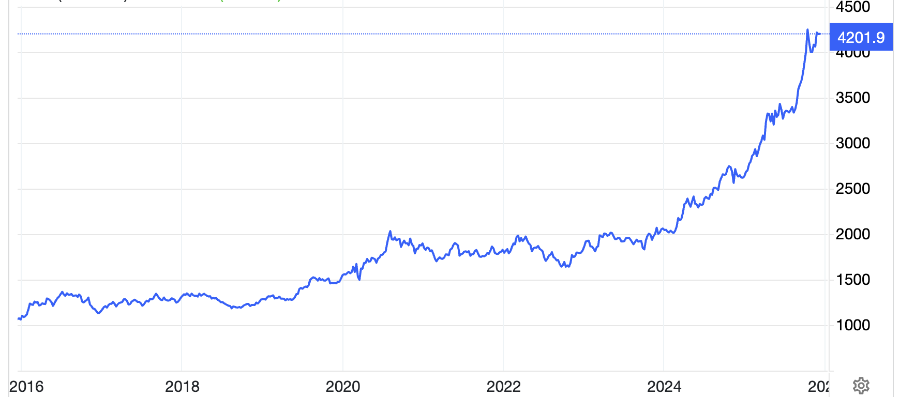
The final Fed meeting of 2025 comes as the gold market appears to be forming a solid price base around the 4,200 USD/oz level. Over the past six weeks, gold prices have fluctuated sharply in line with shifting market expectations about Fed rate cuts.
At the Fed’s most recent meeting in late October, Chairman Jerome Powell warned that there was no guarantee the Fed would cut rates in December. That hawkish signal caused markets to sharply reduce their expectations for a December rate cut, pushing gold prices down to nearly 3,900 USD/oz.
Later, as U.S. data showed relatively stable inflation and a weakening labor market, expectations for a rate cut quickly rebounded, lifting gold prices as well. In recent sessions, gold has been holding around the 4,200 USD/oz mark.
Before the October Fed meeting, markets were pricing in a 90% chance of a December rate cut. After the meeting, that probability fell to 30%. Currently, markets again see a 90% chance that the Fed will cut rates at its upcoming two-day meeting on Tuesday and Wednesday.
Gold prices are showing resilience at current levels, but the metal appears to be lacking a new catalyst for a breakout. With limited time left in 2025, some analysts believe a return to record highs before year-end will be a major challenge.
“The future trajectory of gold prices will depend on whether the Fed keeps easing and whether macroeconomic conditions favorable to gold — such as weakening U.S. growth or geopolitical risks — actually materialize. For gold to reach an all-time high, there needs to be a combination of aggressive Fed rate cuts, continued dollar weakness, and rising safe-haven demand. Achieving a new record before year-end would require more than just one rate cut. Instead, a macro shock or a clearly dovish signal from the Fed would be the most critical factors,” said Aaron Hill, head analyst at FP Markets, in an interview with Kitco News.
Besides the interest-rate decision, Barbara Lambrecht, chief analyst at Commerzbank, said she will be watching the Fed’s policy guidance and interest-rate projections. At this meeting, the Fed will release its quarterly update of the rate outlook of the Federal Open Market Committee (FOMC) members — commonly known as the “dot plot.”
In the most recent dot-plot update in September, the Fed signaled two rate cuts in 2026. However, concerns about a slowdown in the U.S. economy and rising political pressure on the Fed have led to expectations that the Fed may cut rates more aggressively next year.
“If FOMC members project more rate cuts for 2026 than they did in September, gold prices will rise further — particularly because the market currently sees almost no chance of a rate cut at the Fed’s first meeting of the new year,” Lambrecht noted.
Senior analyst Lukman Otunuga of FXTM said gold price volatility is likely to increase due to the many uncertainties surrounding the Fed’s policy direction.
“The Fed is expected to cut rates for the third time this year at the upcoming meeting, but the outlook for 2026 is very difficult to predict. The absence of nonfarm payrolls and October CPI data — due to the government shutdown — will force the Fed to rely on incomplete information at a time when the FOMC is divided. Any unexpected signal from the Fed could trigger greater volatility in gold prices. Technically, if gold breaks above 4,240 USD/oz, it could surge toward 4,300 USD/oz. Conversely, if it falls below 4,200 USD/oz, it may slip to 4,180 USD/oz and 4,160 USD/oz,” Otunuga said.
Eric Strand, founder of precious metals firm AuAg Funds, believes current gold market sentiment is strong and unlikely to be swayed by a single rate decision. According to Strand, regardless of the Fed’s signals this week, interest rates have only one direction to go — down — and the Fed will eventually have to launch another round of quantitative easing (QE).
“Large fiscal deficits and high public debt mean a significant amount of new money will be printed. For this reason, gold prices will continue to rise,” he said.
Similarly, David Morrison, senior analyst at Trade Nation, said any dip in gold prices this week should be viewed as a buying opportunity. “It would take another major sell-off in the gold market for the bears to gain control. That is unlikely, but if it does happen — if gold falls to the 3,800–3,600 USD/oz range — that would be the opportunity to buy and wait for a fresh explosive rally to new highs,” Morrison stated.
At around 7 a.m. this morning (Dec 8, Vietnam time), spot gold in the Asian market rose 2.7 USD/oz from last week’s close in the U.S., up 0.06%, trading at 4,202 USD/oz. Based on Vietcombank’s USD selling rate, this corresponds to roughly 133.7 million VND per tael, an increase of 100,000 VND per tael from the weekend.
At the same time, the Vietcombank website listed the USD at 26,138 VND (buying) and 26,408 VND (selling), unchanged from last week’s close.
















Leave a Reply