


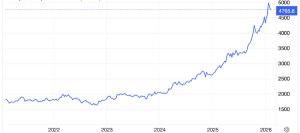
Precious metals rebounded in early trading this morning (February 3), following a sell-off in Monday’s session (February 2) that pushed gold prices to close nearly $1,000 per ounce below their record high.
The rebound in the U.S. dollar was one of the factors behind the early-week sell-off, while the world’s largest gold ETF, SPDR Gold Trust, kept its holdings unchanged.
At the close of the U.S. session, spot gold fell $230.7 per ounce, or more than 4.7%, to $4,660.7 per ounce, according to data from Kitco.
Spot silver declined $6.03 per ounce, or nearly 7.1%, to $79.37 per ounce.
Spot platinum dropped 3.2% to $2,129 per ounce.
On COMEX, April 2026 gold futures slipped 1.9% to settle at $4,652.6 per ounce.
This closing price was more than $900 per ounce below the record high of nearly $5,600 per ounce set in the middle of last week. During earlier Asian trading, gold prices at one point fell to just above $4,400 per ounce—nearly $1,200 per ounce (over 21%) below the peak. Silver briefly dropped to just above $71 per ounce, about $50 per ounce (nearly 42%) below its record high.
Before this session, gold had already fallen 9% and silver more than 26% in Friday’s trading. For gold, it was the largest absolute one-day drop ever recorded, while for silver it marked the steepest decline since the 1980s.
This historic sell-off in precious metals was driven largely by the nomination of Kevin Warsh by U.S. President Donald Trump to serve as the next Chair of the Federal Reserve. If confirmed by the Senate, Warsh would replace Jerome Powell when Powell’s term officially ends in May.
Warsh, a former Fed governor, is widely seen as a monetary policy hawk who prioritizes fighting inflation and is considered capable of preserving the Fed’s independence from political pressure.
The U.S. dollar’s rebound following news of Warsh’s nomination also exerted significant downward pressure on gold prices, alongside profit-taking after gold’s rapid and sharp rally since the start of the year.
The Dollar Index closed Monday’s session up more than 0.6% at 97.6, the highest level in over a week. Over the past five sessions, the index has risen nearly 0.6%, according to MarketWatch data.
In addition, precious metal prices declined as geopolitical tensions showed signs of easing. Over the weekend, Trump said Iran was “seriously negotiating” over its nuclear program. Also last week, Danish officials expressed optimism following a meeting in Washington between senior officials from Greenland, Denmark, and the United States to discuss Greenland-related issues.
At their peak before the historic plunge, gold prices were up nearly 30% year-to-date, while silver had surged around 70%.
Despite the extreme volatility, analysts argue that the recent drop should not be viewed as the beginning of a prolonged downtrend in precious metals.
“The fundamental conditions for a sustained bearish reversal in gold prices do not appear to be in place,” said Michael Hsueh, an analyst at Deutsche Bank, in a research note. He emphasized that strong dip-buying demand is present and that the market is experiencing a shakeout rather than a major shift in investor sentiment.
Other analysts noted that the recent plunge in gold and silver prices may have flushed out speculative traders, helping the market cool in a healthy way and reducing excessive speculation.
In a move that could further curb speculation, CME Group announced on Friday that it would raise margin requirements for precious metals futures contracts, effective after the market closed on Monday.
The world’s largest gold ETF recorded no net buying or selling at the start of the week, keeping its holdings unchanged at 1,087.1 tonnes of gold.
Christopher Forbes, Head of Asia and the Middle East at CMC Markets, said the recent decline in gold prices was a classic correction following an overheated rally, rather than a breakdown of the long-term uptrend. “Profit-taking, a stronger U.S. dollar, and easing geopolitical tensions have weakened what had become an overly crowded trade,” he said.
According to Forbes, gold prices are likely to remain elevated in the near term, but volatility will stay high as the market awaits greater clarity on Warsh’s policy stance. “If the U.S. dollar weakens again or Warsh is confirmed to be more dovish, buying interest will return strongly to the gold market,” he said, adding that gold prices are still expected to rise over the next 12 months and could revisit record highs if the Fed continues to ease monetary policy.
Sharing a similarly bullish outlook, JPMorgan Chase forecasts that gold prices will reach $6,300 per ounce this year, driven by continued demand from investors and central banks.
Precious metals rebounded sharply at the open of the Asian session this morning.
As of 6:30 a.m. Vietnam time, spot gold in Asia was up nearly $85 per ounce from the U.S. close, or more than 1.8%, trading at $4,745 per ounce. Silver rose 3.3% to $81.94 per ounce.
This spot gold price is equivalent to around VND 150 million per tael when converted using Vietcombank’s U.S. dollar selling rate.
At the same time, Vietcombank’s website listed the U.S. dollar at VND 25,790 (buying) and VND 26,180 (selling), up VND 70 on both sides compared with yesterday morning.

















Leave a Reply