


President Donald Trump signed the funding bill into law late on November 12 (U.S. time), officially ending the longest federal government shutdown in U.S. history.
The bill was passed by the House of Representatives earlier that day with a vote of 222–209, just hours before the shutdown was set to enter its 43rd day.
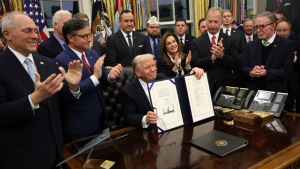
“The Democrats tried to blackmail our country,” Trump declared during the signing ceremony in the Oval Office, attended by Republican congressional leaders. “Republicans never wanted a shutdown. The American people have been hurt very badly.”
The President also emphasized, “We can never let this happen again,” while reiterating his call for the Senate to abolish the 60-vote rule required to pass legislation, including short-term funding resolutions.
Democrats had blocked the passage of the funding bill until Sunday (November 9), when a group of Democratic senators agreed to support it, paving the way for the shutdown to end.
The House vote revealed deep partisan divisions. Only two Republicans—Thomas Massie of Kentucky and Greg Steube of Florida—voted against the bill, while all Democrats except six voted in opposition.
The crisis began on October 1, when Senate Democrats refused to vote for a funding bill that excluded an extension of enhanced tax credits—provisions that help reduce health insurance costs for 20 million Americans under the Affordable Care Act (ACA).
The impact of the shutdown spread across multiple sectors. Before the bill’s passage, the U.S. Department of Transportation was forced to suspend flight reduction measures due to a shortage of air traffic controllers. As of Tuesday (November 11), 6% of scheduled flights had been canceled at U.S. airports, and that number was expected to rise to 10% by the weekend.


















Leave a Reply