


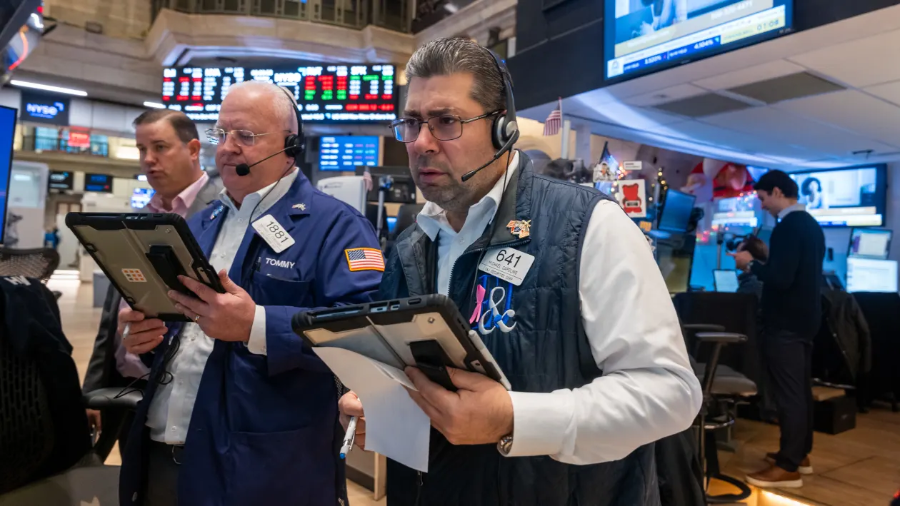
U.S. stocks rose in Tuesday’s trading session (Dec. 2), supported by a rebound in Bitcoin and gains in several mega-cap tech stocks after the previous day’s sell-off.
Crude oil prices weakened as investors assessed the fragile prospects for a Russia–Ukraine peace agreement and signs of oversupply in the oil market.
At the close, the Dow Jones Industrial Average increased 185.13 points, or 0.39%, to 47,474.46. The S&P 500 rose 0.25% to 6,829.37. The Nasdaq gained 0.59%, closing at 23,413.67.
Bitcoin climbed roughly 7%, reclaiming the 90,000 USD level after dropping below 86,000 USD during Monday’s session. Many artificial intelligence (AI) stocks also moved higher, acting as pillars for the major indexes.
Shares of AI chipmaker Nvidia gained about 1%, while AI infrastructure company Credo Technology surged 10%, reaching an all-time high after reporting better-than-expected earnings.
However, the indices fluctuated sharply throughout the session. At some points, both the S&P 500 and the Dow turned negative, while the Nasdaq was nearly flat before rebounding.
On Monday, U.S. stocks saw a steep decline, ending a five-session winning streak from the previous week. Risk-off sentiment has pressured the market in recent weeks as investors worry about persistent inflation, elevated valuations of AI stocks, and uncertain prospects for returns from AI-related investments.
After a volatile November, equity investors on Wall Street are waiting for new catalysts that could fuel a year-end rally. They remain optimistic that the U.S. Federal Reserve (Fed) will cut interest rates at its meeting next week.
“The market seems to have moved past the anxiety related to Fed policy. As a result, investors are focusing on better-than-expected earnings forecasts for listed companies in Q4 2025 and in 2026. They also believe U.S. economic growth will accelerate in 2026 compared to the current slowdown. Seasonality is also favorable for equities in December, especially after a weak November,” said strategist Dough Beath of Wells Fargo Investment Institute in an interview with CNBC.
On the energy market, Brent crude futures in London fell 0.72 USD/barrel, or 1.14%, to 62.45 USD/barrel. WTI crude futures in New York dropped 0.68 USD/barrel, or 1.15%, closing at 58.64 USD/barrel.
Before this decline, both oil benchmarks had risen more than 1% on Monday.
Investors are monitoring the progress of Russia–Ukraine peace talks, as Russian President Vladimir Putin met with U.S. President Donald Trump’s special envoy Steve Witkoff and Trump’s son-in-law Jared Kushner at the Kremlin on Tuesday.
Ahead of the meeting, Putin warned European powers that if they wage war against Russia, Moscow is ready to fight. He also stated that Russia could cut Ukraine’s access to the sea in response to Ukrainian drone attacks on Russia’s covert oil tanker fleet in the Black Sea.
On Thursday, Putin will begin a two-day visit to India, where discussions may include urging India to purchase more Russian crude oil and weapons to strengthen energy and defense ties between Moscow and New Delhi amid U.S. pressure on both countries.
According to analyst Phil Flynn of Price Futures Group, these developments are weighing on oil prices, as they suggest Russia may continue supplying crude to India. On the other hand, Putin’s remarks also indicate that Russia and Ukraine may not reach a peace deal anytime soon, contrary to market expectations.
Analyst Janiv Shah of Rystad Energy said that global crude oversupply is exerting downward pressure on oil prices, though this is partly offset by attacks on Russian oil infrastructure and rising tensions between the U.S. and Venezuela.
In a sign of concerns over excess oil supply, the OPEC+ alliance—comprising OPEC members and partners such as Russia—agreed over the weekend to halt production quota increases in Q1 2026.


















Leave a Reply